
There is something almost disorienting about encountering art that asks you to slow down. Not because the work itself is difficult to understand, but because we have become so deeply conditioned toward immediacy that slowness now feels unfamiliar. We move through images quickly, through grief quickly, through beauty quickly, entire histories collapsing into passing visuals on glowing screens before we have fully absorbed what we are looking at, everything competing for attention while very little asks us to sit with what we are actually feeling long enough for contemplation to emerge.
And perhaps that is partly why Aatif Jutt’s work feels so affecting. Not simply because the paintings are visually striking, though they are, but because they resist that speed entirely. The work asks something quieter from the viewer, something closer to patience and emotional presence than immediate reaction.
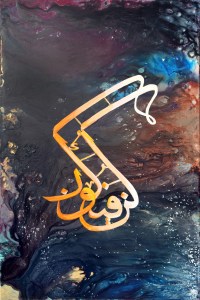
The first time I spent time with his paintings, I kept returning to the same feeling: that the work seemed less interested in spectacle than in remembrance. Sacred architecture dissolves into landscape. Calligraphy curves through light and shadow, almost like movement. Figures emerge not as rigid portraits but as emotional presences. The paintings unfold gradually through layers of symbolism, spirituality, Islamic history, memory, and atmosphere, but never in a way that feels ornamental or over-explained. Nothing feels forced upon the viewer. Meaning reveals itself slowly, almost the way memory or faith itself often does.
And that slowness feels important. Because so much contemporary visual culture now feels detached from spirit. Images are flattened into content before they are fully experienced. Beauty is consumed quickly and forgotten quickly. Even conversations around Muslim identity are often reduced to politics, trauma, or visibility alone, leaving little room for complexity, softness, longing, or awe.
Jutt’s work quietly resists that reduction, not through spectacle or grand declarations, but through a visual language that feels deeply contemplative and emotionally sincere, one that allows spirituality, memory, and beauty to exist together without flattening them into symbols emptied of meaning. There is faith throughout the paintings, though not in a didactic sense. It exists more like an atmosphere woven quietly into the work itself, surfacing through contemplation, yearning, memory, and the feeling of emotional inheritance carried across generations. Looking at the work feels less like receiving instruction and more like entering a space of reflection.
And perhaps that is what stayed with me most while sitting with both the work and his reflections on it, the understanding that art, for Jutt, does not exist separately from spirituality or selfhood, the two appearing deeply intertwined in ways that continuously shape one another. The relationship between creativity and faith within his work traces back not only to artistic instinct but to a deeper search for meaning itself.

In many ways, that slowness feels central to what makes the work resonate. At a time when so much visual culture feels detached from spirit or emotional depth, Jutt’s paintings seem interested in reconnecting people to something more inward. Faith appears often throughout the work, though not as rigid instruction so much as remembrance, longing, contemplation, and an attempt to preserve beauty and meaning within a world increasingly shaped by noise, distraction, and emotional disconnection.
When I ask him about the relationship between spirituality and creativity within his work, he traces the shift back several years, to a period where art became something far more personal than aesthetic expression alone.
Every artist has a moment, or perhaps a series of moments, when art shifts from being an interest to something essential. When did you first realize that creating art was something you could not separate from who you are?
Aatif Jutt:
From my earliest memories, I’ve always been fascinated with the process of bringing an idea from imagination to life. I started exploring digital art, graphic design, and other mediums as early as 11-years-old, but I hadn’t begun to understand the importance of fine art until entering adulthood.
While pursuing a more traditional career, a pivotal moment at 18-years-old pointed me toward rediscovering a sense of identity and purpose. Looking within myself for answers, creating art became a spiritual path for me, rediscovering faith while also reconnecting with my creativity. It began as a form of personal expression and grew into something more: sharing a collective vision — art to inspire faith, to connect with our spirituality, and to remind us of what matters most.
Now, 8 years into the journey of fine art, there are constant realizations that art is inseparable from who I am, especially when hearing how the artwork impacts the community.
The phrase “spiritual path” lingers long after reading it, perhaps because it reveals something essential about the way he approaches creating, spirituality functioning not as performance or aesthetic language, but as something inseparable from the act of making itself. Reflection, contemplation, intuition, and presence surface repeatedly throughout his work and the ideas surrounding it, art becoming less a form of production than a way of deepening spiritual and emotional awareness over time. His artistic education was largely self-directed, shaped through years of research, experimentation, and observation.
Looking back on your early years, what experiences, environments, or people first shaped your creative instincts and led you toward the kind of work you create today?
Aatif Jutt:
My journey with practicing art has mainly been shaped by self-learning and research. I’m grateful to have grown up in the age of the internet, where we can study art history in an intricate, personally directed way that was never possible before. I’m also very blessed to be growing in a generation that understands the arts and their implications on a deeper level. This has opened me up to amazing community events that explore themes of art, identity, and expression.
There have been many influences in my life that have shaped my expression. From family and friends today, to teachers in childhood, to scholars I’ve come across who teach spirituality and Islam, it would be difficult to recall them all. I believe a lot of creative instinct comes from walking the path of creativity itself, through which inspiration appears along the way — instinct and presence. I would attribute any good in my creative instinct to blessings from God.
There is a humility in the way Jutt speaks about inspiration that feels increasingly rare within contemporary conversations around art, where creativity is often framed through the language of branding, individuality, and constant visibility. Jutt does not describe creativity as ownership over ideas so much as openness toward them, as though inspiration is something encountered through presence and attentiveness rather than controlled outright. The work, in many ways, feels guided by observation and contemplation rather than pure control.
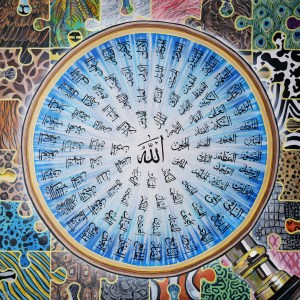
That relationship between spirituality and art deepened significantly in 2019 after he was commissioned to create a piece centered around the 99 Names of Allah, something he describes as a pivotal turning point in his creative journey.
Your work often draws from Islamic history, symbolism, and spirituality. When did you first begin exploring faith as a central element in your artistic expression?
Aatif Jutt:
Late 2018 was when I first began my dedicated journey in fine art and painting. Initially, my inspiration was drawn from pop culture influences and focused on what was aesthetic and fun to create. In 2019, I was commissioned to create an artwork of the 99 Names of Allah, and this became a pivotal moment where I realized how spirituality and art connect.
With Islam and faith being core to my being, creating from a place of awareness of God and the spiritual realm felt completely different. This is when things started to take on a journey of their own. Each artwork would lead me into hours of contemplation, and reflecting on the Creator of all creativity sparked something that forever changed how I view art. It felt more natural, more purposeful, more aligned with who I was, and also with how it resonated with the community.
Each artwork leads me into hours of contemplation — to reflect on the Creator and the beauty within nature. The study of the subjects within the composition overlaps with a deeper learning of the self.
That sense of contemplation reveals itself throughout much of his work, particularly in pieces like Journey to Mecca, where spiritual longing and modern life exist in visible tension with one another. The painting feels emotionally recognizable before one even fully understands its symbolism, carrying within it both movement and exhaustion, a searching for stillness amidst the overwhelming pace of contemporary life and the quiet emotional fatigue that comes with trying to remain spiritually grounded while existing within systems that constantly pull attention outward.
That tension feels especially resonant now. Many people, particularly younger Muslims navigating modern life, understand intimately the feeling of existing between worlds, caught somewhere between productivity and spirituality, material ambition and inner fulfillment, visibility and genuine presence. There is often a quiet grief in realizing how difficult it can become simply to remain connected to oneself long enough to feel spiritually present at all. What makes Journey to Mecca compelling is that it never attempts to simplify that contradiction. The work sits inside it, honestly.
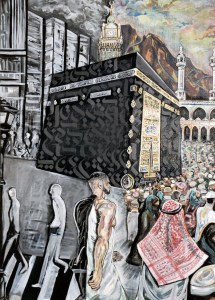
In pieces like Journey to Mecca, there is a sense of longing for spiritual connection and a contrast between worldly life and something more transcendent. What inspired that piece, and what were you hoping viewers might reflect on when encountering it?
Aatif Jutt:
Yes, Journey to Mecca explores the duality between the material and spiritual realms. With the rush of modern-day life, there is often a gap between nourishing the soul and nourishing the body. This piece aims to express the movement toward a balanced life: fulfilling the material while remaining spiritually grounded.
That balance between the individual and the collective also appears throughout his work. Even while exploring deeply personal themes of spirituality and introspection, there remains a visible concern for community, belonging, and shared identity.
Works such as One Ummah emphasize unity and collective identity within the Muslim community. What inspired that piece, and how do you think art can contribute to a shared sense of belonging or solidarity?
Aatif Jutt:
One Ummah shares the beauty of unity amongst all believers, regardless of background, race, age, or gender. Through painting and fine art, we can communicate in a way words sometimes cannot — but that is equally as important. The artwork shares a collective vision of faith, honouring what matters most and connecting us all as human beings and believers.

Symbolism within his work operates less like hidden messaging and more like layered reflection, meanings surfacing gradually through intuition, repetition, and emotional association rather than direct explanation.
When translating something deeply spiritual into visual form, how do you approach that responsibility as an artist?
Aatif Jutt:
My paintings aim to share a message through storytelling compositions, with each colour and shape working in cohesion. The artwork forms organically through contemplation and reflection. The responsibility lies in showing up to the canvas, but in many ways, the artwork creates itself. Intention must always be in the right place, and you must remain open to the inspiration that comes your way.
Your piece referencing the Lote Tree draws from powerful imagery within Islamic tradition. What draws you to these spiritual symbols, and how do you decide which stories or ideas to explore visually?
Aatif Jutt:
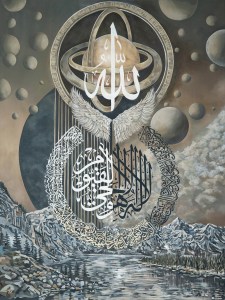
The Night Journey (Isra wal Mi‘raj) was a pivotal experience in the life of Prophet Muhammad صلى الله عليه وسلم and shaped the message of Islam forever. The Lote Tree, being at the utmost boundary of the seven heavens, marks the place beyond which is only the Throne of Allah. It’s a powerful symbol described in the Qur’an and narrations of the Prophet Muhammad صلى الله عليه وسلم in a beautiful, awe-inspiring way.

Through this artwork, one may reflect on the story of Mi‘raj, the beauty within God’s creation, and the abundance of life. Ideas often come intuitively when contemplating what inspires faith. Knowing the importance of these symbols within both historical and spiritual contexts gives me confidence that they will resonate positively with others.
There is an openness within the way Jutt speaks about creating that feels increasingly rare in contemporary conversations around art. The work is intentional, yet never over-controlled, and he speaks about creating in a way that leaves room for intuition, emergence, and the unexpected shifts that happen once a painting begins taking on a life of its own.
Many of your works contain layers of symbolism that reveal themselves the longer someone looks at the piece. How intentional is that process when you are building a composition?
Aatif Jutt:
Every bit of symbolism is intentional at first; however, oftentimes the artwork begins to reveal new patterns and correlations as it manifests. There is a delicate balance between intentionally placing meaningful symbolism and allowing the artwork to take on an expression of its own.
When you begin a new piece, do you usually start with a clear concept or message in mind, or does the meaning reveal itself gradually through the act of creating?
Aatif Jutt:
It often starts with a simple idea and builds from there. It may begin with a verse, a historical event, a place I have visited, or a conversation. As you start to sketch and place forms within the artwork, you remain open to inspiration, and it becomes an active process of micro-adjustments, additions, and subtractions.
The core idea stays the same, and you only take steps that help clarify the message. Sometimes the artwork ends up very close to what I initially imagined, but most of the time the process creates space for refinements and unexpected discoveries.
What does your creative process typically look like from the initial idea to the final piece?
Aatif Jutt:
The creative process consists of reflection, meditation, and contemplation in order to gather an idea that resonates. From there, it evolves into a sketch and then into a painting, continuously refining while keeping the vision clear and focused on invoking a feeling of faith.
The technical process is quite in-depth and layered, working through dimensions of composition, line and shape, value, and hue.
Artists often speak about learning to embrace imperfection in their work. How do you personally balance control with allowing a piece to evolve naturally?
Aatif Jutt:
A lot of the time, while painting, I study the forms and subjects between sessions throughout the process. This allows time to build in the technical approach, while when the paintbrush is on the canvas, it’s all about allowing things to flow naturally.
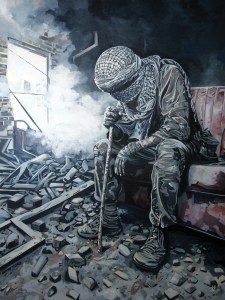
Art, for Jutt, never feels confined to output alone. It becomes a way of processing the world internally, of moving through transformation, uncertainty, and spiritual reflection in real time.
Has creating art ever helped you process something personal or transformative in your life?
Aatif Jutt:
Always. Every artwork creates room for a new perspective and invites you to explore its message on a transformative level. You must understand the message in a personal way in order to express it authentically.
That emotional sincerity becomes especially visible in the works centered around historical figures like Malcolm X and Muhammad Ali. In MALCOLM X MOTAZ, Jutt explores Malcolm not simply as an icon, but as someone whose moral clarity and commitment to justice continue to resonate politically and spiritually across generations.
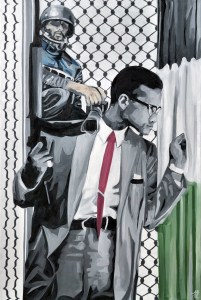
Your piece MALCOLM X MOTAZ pays tribute to Malcolm X, a figure whose legacy continues to shape conversations around faith, justice, and liberation. What inspired you to create this work, and what does Malcolm X represent to you personally as both a Muslim and an artist?
Aatif Jutt:
Malcolm X is an inspiration to all who study and understand his story. His life is exemplary of the extraordinary lengths one person can go to stand for what they believe in. He was outspoken for the right reasons, and his truth stood out in a way that caused others to reflect on their own truths through him.
This artwork explores his connection to Palestine and how he stood for justice for all people. The painting references the famous photograph of Malcolm X in his Manhattan hotel room shortly after his family home was attacked while they were inside. The original photograph was taken by Don Hogan Charles.
Similarly, I AM ALI moves beyond athletic legacy and into something more human and spiritual.

In your piece, I AM ALI, you honor Muhammad Ali, whose life blended athletic greatness with spiritual conviction and political courage. What drew you to Ali as a subject, and how do you think his legacy resonates today?
Aatif Jutt:
Ali is an example of a man who was excellent in his craft while also displaying remarkable character in his humanity. His faith inside the ring reflected the way he carried himself outside of it and the impact he had on everyone around him. This artwork specifically explores him praying in the corner of the ring before a fight. Above him reads “Hayya ‘ala al-falah” — “Rush to success” — while expressing that all success belongs to Allah and that our trust is in Him alone.
At the center of much of Jutt’s work is the understanding that art cannot really be separated from humanity itself, that spirituality, memory, displacement, identity, emotional inheritance, and questions of justice inevitably bleed into one another, whether intentionally or not. That overlap feels especially significant in the context of Muslim artistic expression today. Much of the public imagination surrounding Muslims remains shaped through flattening narratives: conflict, surveillance, politics, violence, and displacement. Rarely are Muslims granted emotional or artistic complexity within mainstream visual culture. Rarely are spirituality, beauty, softness, interiority, or awe centered.
And this is part of what makes the work feel quietly radical, not because it shouts or attempts to position itself as overt resistance, but because it refuses reduction altogether, insisting instead on complexity, interiority, spirituality, and emotional depth at a time when Muslim identity is so often flattened into political shorthand or spectacle. Jutt’s paintings reclaim Muslim visual language not through reactionary aesthetics, but through sincerity and stillness, through the insistence that faith itself deserves contemplation outside of stereotype or performance.
In many ways, the work participates in a larger act of preservation, preserving sacred imagery, emotional memory, collective identity, and forms of spiritual language that many people instinctively recognize yet rarely encounter reflected back with this level of care. That preservation becomes especially emotionally charged in works centered around Palestine and Al-Aqsa, where questions of memory, resistance, spirituality, and humanity collapse into one another.

Several of your works reference Palestine and sacred places such as Al-Aqsa. At a time when the region remains at the forefront of global attention, why do you feel it is important for artists to continue creating work that speaks to Palestine, memory, and resistance?
Aatif Jutt:
I believe art is a beautiful form of expressing our truth as humanity. It is a reflection of who we are and our collective conscience. Art is about being human, and so is standing with Palestine.
The conversation naturally shifts toward identity and representation more broadly, particularly the ways Muslim narratives continue to be flattened or misrepresented culturally.

The theme of Reclamation Magazine centers around reclaiming identity, voice, and narrative, especially for communities whose stories are often misunderstood or misrepresented. In what ways do you feel your art contributes to reclaiming Muslim identity, history, or collective memory?
Aatif Jutt:
Art works to build a collective vision of truth while challenging the false narratives surrounding Muslim culture and identity, often portrayed in the media. It becomes an extension of us, manifesting within our spaces and inviting contemplative thought about living empowered lives through a renewed perspective.
The paintings never seem interested in representation for representation’s sake. The paintings are not attempting to flatten faith into aesthetic symbolism or reduce spirituality into visual motifs detached from meaning. There is too much sincerity within the work for that. Instead, the paintings function almost as acts of remembrance, preserving faith, history, beauty, collective identity, and the emotional and spiritual worlds many people carry internally yet rarely see reflected back at them with this level of care or intentionality. In many ways, that is what makes the work feel so emotionally resonant. Not simply the imagery itself, but the space it creates for contemplation. The permission it gives the viewer to slow down long enough to reflect on something deeper than immediacy.

What is something about your artistic journey that people often do not see behind the scenes?
Aatif Jutt:
99% of it is behind the scenes — art is a way of life. It’s about observing and reading life’s experiences while expressing what stands out and elevates the spirit. To share your authentic truth and message, you have to explore those things deeply within yourself. A feeling of faith has to be felt. To inspire awe, you first have to understand what is awe-inspiring.
Looking at your earlier work compared to what you create now, how do you feel you have evolved as an artist and as a person?
Aatif Jutt:
Exploring themes of spirituality has opened me to a world of study that has definitely brought positive change into my life. On a technical and craft level, growth naturally comes with time. When combined with a vision that continues to refine itself and connect with the collective vision of the community, the art begins to take on a journey of its own.
Is there a particular piece you have created that holds especially deep personal meaning for you?
Aatif Jutt:
All of my artwork carries deep personal meaning, including commissioned pieces. Understanding the message we want to share creates space for me to develop a personal relationship with that message, contemplating it within myself while studying and researching the subject.
If someone encounters your work for the first time years from now, what do you hope they feel or take away from it?
Aatif Jutt:
Art that inspires faith, invoking a feeling of joy and empowerment. I hope to share a new perspective — a contemplation on the beauty of nature and spirituality.
That desire to leave people with a feeling rather than simply an image feels deeply connected to the emotional atmosphere of the work itself. The work never feels interested in spectacle for spectacle’s sake, nor in loudly announcing its meaning, which is perhaps what makes its sincerity feel so unmistakable. What lingers most after spending time with Jutt’s work is not simply the symbolism itself, nor even the technical mastery behind the compositions, but the sincerity running quietly through them, the sense that the paintings emerge from genuine contemplation rather than performance, less interested in appearing profound than in honestly wrestling with questions of faith, beauty, meaning, memory, and spiritual presence.
At one point during our conversation, Jutt describes art as “a way of life.” The phrase feels revealing. Because nothing about the work suggests distance from what is being expressed. The paintings do not feel observational from afar. They feel lived in. There is something deeply human about that, especially now, at a time when so much visual culture feels engineered for immediacy, reaction, and consumption rather than reflection or emotional presence. And perhaps that is why the paintings linger. Not because they overwhelm the viewer or loudly announce their meaning, but because they ask us to slow down long enough to reconnect with something many people have quietly been searching for all along, a sense of spiritual grounding and emotional presence in a world that increasingly pulls us away from both.
What advice would you give to young artists who want to explore themes of faith, culture, and identity in their work?
Aatif Jutt:
I would say: do it. Stay true to yourself, remain open and patient with the process, and most of all, enjoy it.
Toward the end of the interview, I ask whether there is anything he wishes people engaged with more often when approaching the work.
Aatif Jutt:
I always love speaking about the art and the ideas behind it. Thank you for this interview and for sharing the vision. Conversations and questions about the art spark new thoughts, and it’s always eye-opening and inspiring for me as well. Thank you!
One line in particular continued lingering with me long after I had finished sitting with both the paintings and the interview itself. “To inspire awe, you first have to understand what is awe-inspiring” – it feels, in many ways, like the clearest way to understand the work itself. Not simply as paintings. But as reflections on faith, memory, beauty, and the quiet act of preserving meaning in a world constantly trying to move past it too quickly.

Leave a Reply