
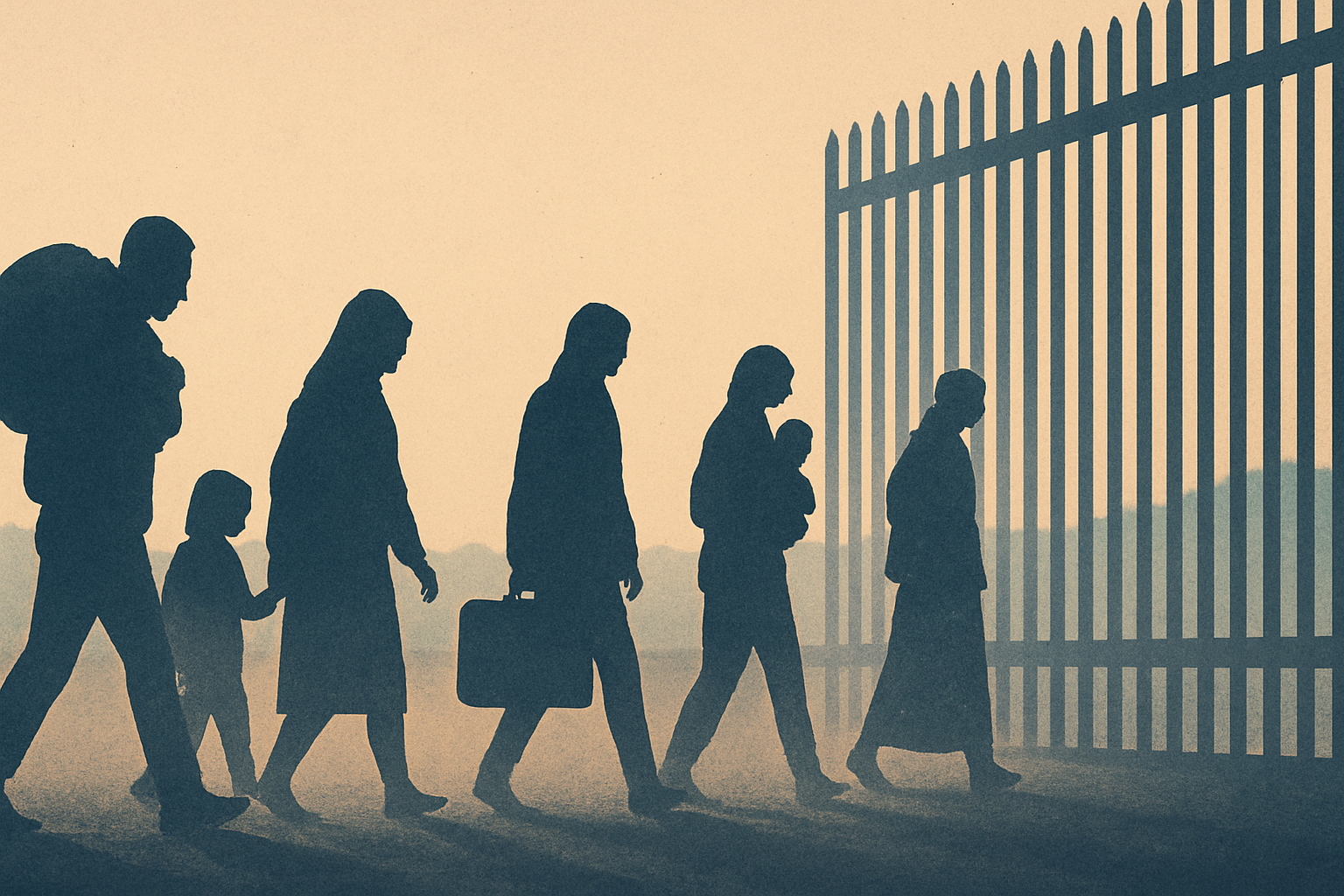
In his second administration, Donald Trump has made a variety of efforts to dramatically reshape immigration in the United States. Here’s a breakdown of Trump’s major immigration moves since reelection.
Birthright Citizenship
The 14th Amendment states that anyone born within the United States is automatically granted citizenship. On his first day in office, Trump attempted to further restrict this right through an executive order, stating citizenship “does not automatically extend” to those born to illegal immigrants or even temporarily legal immigrants. This was followed by a number of lawsuits as well as rulings to block the order from three separate U.S. district judges. The White House appealed, putting the future of birthright citizenship in the hands of the Supreme Court. In late June, the Supreme Court restricted the ability of lower-court judges to block executive branch policies nationwide. This means the executive order will go into effect in the 28 states that did not challenge it, starting 30 days after the decision was made on June 27. There will likely be further lawsuits challenging the order in that time. The Supreme Court also did not rule on the constitutionality of the order, which will likely return to the Court in the near future.
Asylum
During his first week, Trump signed several executive orders pausing asylum applications through the U.S. southern border and the federal refugee program. The administration also moved to end temporary protected status and the CHNV program which allows Cubans, Haitians, Nicaraguans, and Venezuelans to enter the U.S. under humanitarian parole. Those in the U.S. legally through now-paused programs are now at risk of deportation or detention. These programs and protections have provided asylum to those fleeing war, economic collapse, dictatorship, and more. Additionally, there have been multiple lawsuits over the number of cancellations of asylum appointments from administration through the Customs and Border Patrol (CBP) app. It has since been relaunched as “CBP Home” and now includes a “self-deport” function in line with the Trump administration’s $200 million dollar advertisement campaign encouraging undocumented immigrants to self-deport.
Furthermore, since the asylum application pause, regulations regarding the U.S. southern border have changed. Trump has increased the number of troops deployed along the southern border by 60%. Migrants arriving at the border are now met with border patrol agents instructed to turn them away without even potential asylum hearings. The administration has also made efforts to reinstate the “Remain in Mexico” policy, which forces non-Mexican asylum seekers to wait in Mexico until their U.S. cases’ resolution, which impacted an estimate of 71,000 people during Trump’s first term. Additionally, with the recent passing of Trump’s “big beautiful bill, $46.5 billion has been allocated to complete Trump’s border wall, $5 billion has been allocated for CBP facilities, and $10 billion has been set aside for other border security initiatives.
ICE
Trump has also expanded the powers of Immigration and Customs Enforcement (ICE) through a multitude of executive orders. This includes the ability for immigration raids in previously prohibited areas like hospitals, schools, and churches as well as delegation of ICE duties and authority to other law enforcement such as local and state police, the FBI, and U.S. Park Police. During the Border Security Expo in April, ICE director Todd Lyons said he wishes to see a deportation process “like [Amazon] Prime, but with human beings.”
According to Time, data has shown a 25% increase of the average number of people held in detention centers. The administration has also asked for increased funding from Congress. With the recent passing of Trump’s “big beautiful bill, $45 billion has been allocated for immigration detention centers and $30 billion has been allocated for other ICE expansions.
In early June, Trump instructed ICE to pause raids on farms, hotels, and restaurants, on account of its detriment to these particular industries. He said that employers in these industries have expressed how his aggressive policies are “taking very good, long time workers away from them, with those jobs being almost impossible to replace.” Trump has previously spoken about accommodating the needs of farmers, who remain one of his stronger demographics of support.
Alien Enemies Act
Trump has also sent migrants to be detained overseas, often without due process, to places such as Guantanamo Bay in Cuba and El Salvador’s prison Centro de Confinamiento del Terrorismo (CECOT), notorious for its alleged human rights violations. These efforts have been made using the Alien Enemies Act of 1798 which is a wartime measurement giving the president authority to detain or deport the natives and citizens of an “enemy” nation without due process. The last time a President invoked the Act was during World War II. Trump first used this Act in March, with efforts of targeting alleged members of the Venezuelan gang Tren de Aragua. This authorized the removal of all Venezuelan citizens without U.S. citizenship or legal residence above the age of fourteen and deemed members of the gang. This move was challenged by the U.S. District Judge James Boasberg who issued an order temporarily blocking the use of the Act for deportation and ordering the administration to turn around the three deportation planes already in the air, which they did not. Over 100 were deported. Additionally, a variety of activist groups and publications have questioned the administration’s justification for determining some of the deportees as gang-affiliated. Boasberg’s order was upheld in late March and fully restricted further use of the Act of deportation. However, in April, the Supreme Court temporarily upheld the use act for the deportation of the alleged Tren de Aragua members, but granted those deported the ability to contest their detentions and deportations.
The Cases of Mahmoud Khalil and Kilmar Abrego Garcia
Mahmoud Khalil was arrested in March by ICE agents in his university housing apartment building in New York City. He was then taken to a facility in Louisiana where he was held for over three months and was denied the ability to be present for the birth of his daughter. Khalil is an international graduate student at Columbia University and is married to a U.S. citizen, but was ordered by secretary of state Marco Rubio to be deported by a provision of the Immigration and Nationality Act of 1952. This rarely cited Cold War provision grants further authority to the secretary of states in determining when a noncitizen is threatening U.S. foreign policy. On his social media platform TRUTH Social, Trump called Khalil “a radical foreign pro-Hamas student.” Khalil has been vocal about Palestinian rights, participated in campus protests, and mediated between university officials and student activists, but there remains no legal evidence of his support for Hamas. A second allegation was added under his arrest regarding his employment history on his 2024 application for permanent residency. Khalil’s deportation was challenged under unconstitutional violation of his free speech and due process rights. In April, an immigration judge at the Louisiana facility ruled the deportation was valid under Rubio’s authority, which has since been appealed. In June Michael E. Farbiarz of Federal District Court in Newark stated there was “at least something” to the argument that the immigration charge was being used unconstitutionally and that the provision invoked by Rubio did not justify deportation. The Trump administration asserted that Khalil should be continued to be held under the employment record allegation, which was ultimately refuted and on June 20 and Khalil was released on bail. The New York Times reports that the administration has the ability to appeal and “will almost certainly continue trying to deport Mr. Khalil.” His immigration case is ongoing. Khalil is one of many of ICE’s noncitizen student arrests, particularly of pro-Palestinan activists.
Kilmar Abrego Garcia was arrested by ICE members when driving home from work with his five-year-old son in March and was deported alongside alleged Tren de Aragua gang members to a prison in El Salvador. Abrego Garcia has no criminal record and despite entering the U.S. illegally, was permitted to stay in the States by an immigration judge in 2019 on the basis that returning to El Salvador was a risk to his safety. In April, the Supreme Court sided with the judge and ordered Abrego Garcia be brought back to the States and that the Trump administration should “facilitate” this return. Instead, the administration maintained that the arrest was justified and that Abrego Garcia is a gang member. Abrego Garcia has been brought back to the U.S. and is now facing criminal human smuggling indictment. A reporter from CNN wrote that the case against him “appears to be so tenuous that a federal magistrate judge in Tennessee strongly questioned whether keeping him locked up pending trial is merited.” The case is still ongoing. Abrego Garcia’s situation highlights the growing tensions between the Trump administration and the courts among immigration cases and due process.

Leave a Reply