
Namibia held its first Genocide Remembrance Day on May 28, 2025 to commemorate the genocide of the Nama and Herero people by German colonisers during the early 20th century. This is the first time that an official memorial has been held in spite of Namibia having been an independent democracy since 1990. That it has taken this long does not surprise me after having spent 3 weeks travelling in the country with a colleague in April this year.
During that time we met with many people, and visited historical sites and museums in Windhoek, Rehoboth and Keetmanshoop. All three are very different, but it is the museum in Lüderitz that left me very unsettled. I have been struggling to reconcile this experience with my visit to Shark Island to attend the commemoration of 12 April, the date of what is considered by the Nama people to be the first act of genocide against them. In 1893, more than 80 women and children were murdered by German troops in Hornkranz and their village burned to the ground.
Shark island, or Death Island, was one of five concentration camps in German South West Africa and the first large-scale death camp. While monuments and plaques abound on the island to commemorate the Germans who died during this period, it was only recently that a monument was erected to those who were exterminated there. Bizarrely, the island has been turned into a camping site with much of the area concreted over and taken up with ablution blocks. The Namibian Wildlife Resorts website advertises “stays in the refurbished lighthouse with 360-degree views over the harbour, the town and the majestic German-influenced buildings”, and “campsites at budget rates, where you can enjoy the beautiful scenery and rich history”.
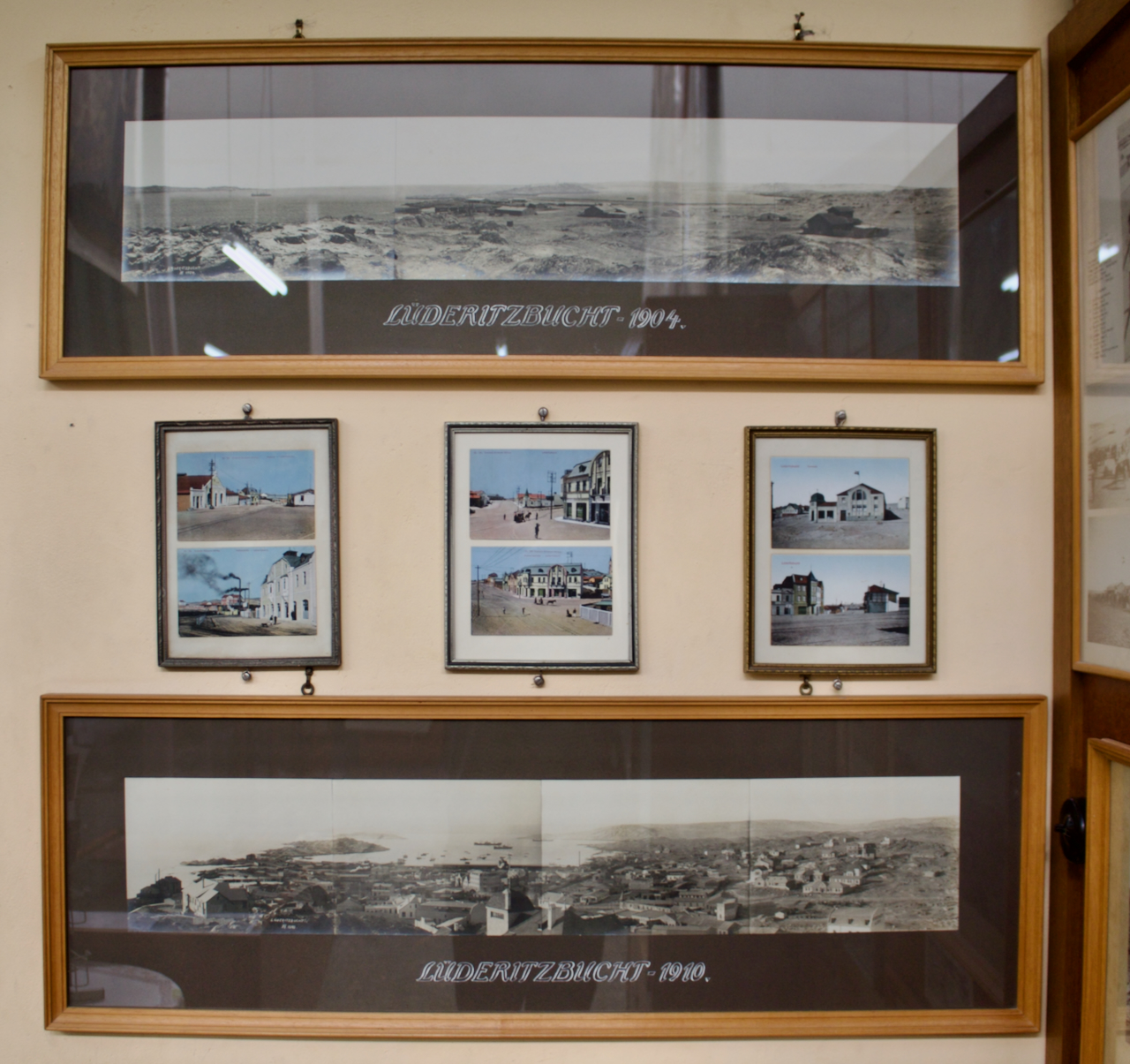
The Lüderitz Museum, a five-minute walk from Shark Island, was started privately during the apartheid era and seems to have changed very little judging by the dusty dioramas and yellowing captions and information boards. Through the glorification of the German occupation as evidenced by the proud displays of uniforms, guns and flags, the erasure of the history of the indigenous Nama and Ovaherero who suffered a genocide at the hands of the German colonisers, is further exacerbated. Black and white photographs of Von Trotha’s Schutztruppe (who committed the genocide on nearby Shark Island) are proudly displayed.
Two photographs of the island taken in 1904 and the other in 1910, neatly eradicate the years 1905 to 1907 when the rape, murder, torture and starvation of more than 4000 men and women occurred. Body parts were sent back to Germany where they were used for pseudo-scientific research. Research agency, Forensic Architecture, in collaboration with descendants of the colonial war, in their digital reconstruction of the site through oral accounts has documented evidence of multiple burial sites.
During our visit to the museum there was a constant stream of visitors, mostly German tourists judging by their accents. I left the museum struggling to understand how this one-sided narrative that erases the suffering of the indigenous people is allowed to exist in its current form more than one hundred years since German occupation ended, and 35 years since Namibian independence. I was shocked by the juxtaposition of the two visits — the commemoration of genocide by descendants and the glorification of the perpetrators. It raises so many questions about accountability and responsibility.
Of even greater concern is the controversial expansion of the port at Lüderitz for “green hydrogen”, an alternative to fossil fuels, funded by the German government. Green hydrogen is an emerging energy source for the economies of the Global North which will enable European countries to decarbonise and meet their own climate change agendas. The expansion of the port is necessary in order to facilitate the extraction of the energy (gained through the region’s wind and solar energy) from Namibia for use in Europe.
Namibian economy needs revenue and the investment in the project would amount to ten billion USD, roughly equivalent to Namibia’s GDP. Colonial powers, including South Africa, have extracted its mineral (diamonds) and marine (fishing, whaling, guano) wealth. Extraction has always sustained colonial rule. So-called green hydrogen (which is not so green when one examines the process) is being touted as development, opportunity and income revenue, but colonialism was never about development, opportunity and revenue for the local people.
While concerns have been raised by community organisations, it is far too easy for authorities to dismiss their objections as standing in the way of development when their history has been so surgically erased. Once again, the hunt is glorified by the hunter and the voices of those who continue to be impacted by the legacies of colonialism, enslavement and apartheid are silenced.
Let’s hope that this first Genocide Remembrance Day will pave the way for more constructive engagement with the people of Namibia.

Leave a Reply