
Featured Image: AFP, South China Morning Post
. . .
The blood of Shia Muslims has stained the streets of places like Pakistan, Afghanistan, and beyond for far too long and yet the world continues to feign ignorance and remains silent. Massacred in buses, bombed in mosques, slaughtered in marketplaces, the calculated attacks to attempt to extinguish the Shia Muslim population fit the framework of a genocide defined by the United Nations, and are carried out in plain sight yet the bloodcurdling screams of these innocent civilians continue to fall upon deaf ears.
“Many of the individuals who perpetrate violence against Shias simply don’t view Shias as Muslims, [leading them to justify the killings of fellow Muslims],” said Zahra Ghadeer, a young Hazara Shia Muslim from Chicago, IL. Ghadeer further goes on to explain that the Quran does not justify the killing of fellow Muslims—Shia or Sunni—nor people of other faiths.”
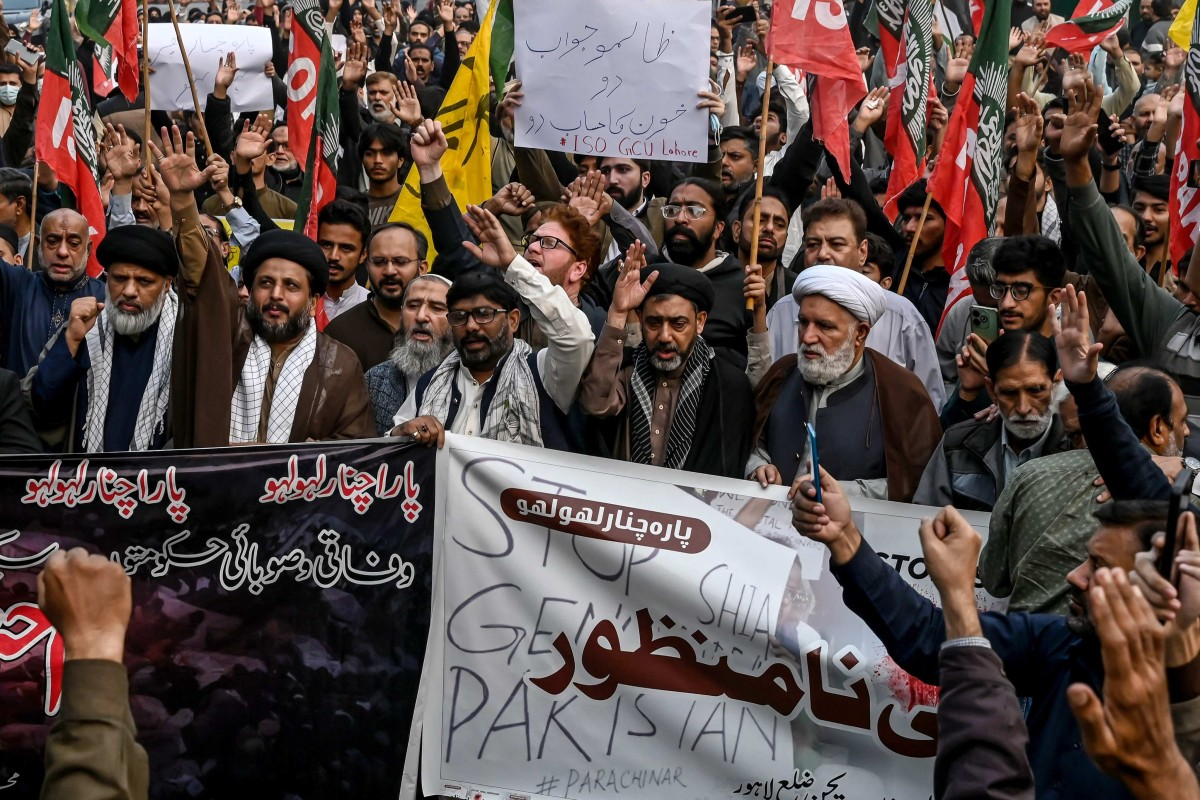
This was Ghadeer’s frustration and opposition to the violent attack against Shia Muslims in Pakistan’s Khyber Pakhtunkhwa (KPK) province. On Nov. 22, over 40 Shia Muslim men and women were shot and killed while traveling in a motorcade from Parachinar to Peshawar. A harrowing image on social media showed bloodied, lifeless bodies lying under the open sky which prompted international outrage over the tragic realities that this minority group experiences in many areas around the world.
The social media platform Unspoken Genocide, which documents attacks on Shia Muslims, attributed the attack to anti-Shia terrorist groups. However, according to Reuters, no group has officially claimed responsibility.
Zaina Khan, a Shia Muslim high school student, shared that this attack left her heartbroken, and fearful that, “the world would remain silent.”
These attacks against Shia Muslims are not rare, and within 2024, they have followed a disturbing pattern, particularly within Pakistan and Afghanistan:
- Sept. 12: 14 Hazara passengers were shot and killed in Afghanistan while on their way to welcome Shia Muslim pilgrims.
- Aug. 25: An attack on a Shia Muslim mourning gathering left two dead. The group Sipah e Sahaba claimed responsibility.
- July 27: Violent attacks on Shia mourners killed at least 60 people.
- Jan. 11: An explosion in the Dasht-e-Barchi area of Afghanistan killed six people and injured 19. ISIS claimed responsibility.
The pattern that we witnessed in 2024 with these attacks follows a disturbing trajectory of targeted killings, strategic and intentional bomb attacks, and worst of all, calculated mass attacks timed around religious gatherings and travel to/from holy pilgrimages. These attacks all testify to the barbaric and intentional efforts to continue terrorizing the marginalized community of Shia Muslims. Extremist groups like ISIS and Sipah e Sahaba have openly taken credit, signaling an organized campaign of sectarian persecution. Recognizing and calling out this pattern is crucial to document the scale of where and when these attacks are launched, but to also highlight to government bodies that as a result of their failed intervention and efforts to establish justice, bloodshed of countless innocent Muslims have drenched their soils especially in gatherings that are sacred and filled with the very mention of the Prophet Muhammad (PBUH) and his family’s efforts to establish good, and annihilate evil.
Qasim Naqvi, a Shia Muslim student at Drexel University, spoke about this grim reality after witnessing several explicit videos online of inhumane treatment against Shia Muslims. Some videos included the throwing of objects at peaceful Shia Muslim demonstrators, vehicle bombings, and beheadings using blunt knives. Like Khan, Naqvi was horrified at how any individual could remain silent on violence that is perpetrated against brothers and sisters within the Ummah.
These injustices are not random acts of violence. Rather, they’re part of a larger systematic effort to target Shia Muslims. This fits the definition of genocide. The persecution of Shia Muslims in Iraq, Pakistan, Syria, Saudi Arabia, and beyond testify to the existence of a global humanitarian crisis that the world continues to ignore.
In the words of Ghadeer—spoken by a Hazara Shia, a minority within a minority—her call is not just for recognition, but for justice in the face of a genocide that the world refuses to see.
To understand the gravity of these ongoing attacks, it is imperative to study and research the roots of sectarian violence, and the roots of Shia persecution in particular. This genocide isn’t a series of horrifying events that have emerged within the last decade, but have actually stemmed over centuries of deep-seated divisions that have not been healed by those in power, and that have been deliberately manipulated for political and ideological gains over centuries. After tracing its origins, we can better grasp how historical narratives have fueled modern-day atrocities and why urgent action is needed to break this cycle of violence.
A brief history behind sectarian violence
Sectarian violence, or violence driven by religious and ethnic divisions, is not confined to just one region or faith. It has plagued human history for centuries and is often exacerbated by political power struggles and manipulated ideologies.
Outside of Islam and the Muslim community, one well-known example is the St. Bartholomew’s Day Massacre of 1572 in France. In mere days, violence intensified between Catholics and Huguenot Protestants which left between 2,000-6,000 Protestants killed in Paris. This massacre occurred due to religious divides that had been left unresolved and political leaders exploiting these tensions for their gain.
Centuries later, another massacre occurred known as the Maspero Massacre in Egypt. In 2011, Coptic Christians protested against the demand to desecrate the St. George Church by Salafi Muslims. During these peaceful demonstrations, armed security forces attacked the demonstrators, killing 28 people, some crushed under military vehicles. Despite video evidence and testimonies, no high-ranking officials were held accountable. Human rights organizations, like the Association for Freedom of Thought and Expression, later accused the Egyptian government for failing to seek justice for the victims.
Although one example occurred in the 16th century and the other occurred only 13 years ago, one major similarity connects both events and allows us to draw modern parallels: sectarian violence only thrives and worsens in bloodshed when governments and those in power allow tensions to fester with no movement to establish peaceful negotiation and holding perpetrators accountable. In the case of the St. Bartholomew Day Massacre and the Maspero Massacre, no one was held accountable for the calamities both minority groups were victims of. As a result, this only worsens the divides between majority and minority groups and continues to allow opportunities for crimes against humanity.
The persecution of Shia Muslims in the modern age
Shia Muslims make up about 10-15% of the global Muslim population, yet they face disproportionate levels of persecution. Their core values of justice, compassion, and sacrifice are often met with cruelty and inequality. Kashif Thada, a Shia Muslim freshman at York University, says, “We are only 10%, yet expressing our beliefs openly can get us killed. This isn’t just discrimination—it’s suppression.”
The persecution of Shia Muslims today is a continuation of centuries-old theological and political divisions. The split dates back to 632 CE, following the martyrdom of Prophet Muhammad (PBUH). Disagreements over his rightful successor led to the emergence of two main sects: the Sunni and Shia Muslims. Sunni Muslims supported Abu Bakr as the first caliph, while Shia Muslims believed that Imam Ali (as), the Prophet’s cousin and son-in-law, was divinely appointed.
This split quickly laid the groundwork for generations of violence, often driven by rulers who exploited these divisions for power as seen in the Umayyad-Abbasid, and Safavid-Ottoman empires. Whether Shia Muslims live overseas or in Western countries, they have been the victims of systemic oppression, misinformation, and bloodshed, and reasons such as “tribal conflicts” have been labeled to disguise the underlying reasons why this genocide continues.
Samin Naqvi, a Shia Muslim student at York University, recalled a horrific story he had heard from the pulpit during a gathering of Shia mourners in Muharram. A Shia Muslim couple were traveling to Karbala, Iraq for pilgrimage during the month of Muharram. “At an ISIS-controlled security checkpoint, the extremist group allowed a non-Muslim to pass but detained the Shia Muslim man and his wife.” Upon confirming their Shia identity, “one of the extremists stabbed the pregnant woman, killing her unborn child. They then mutilated her body and threw both her and the baby into a river. The husband, forced to witness the atrocity, was subsequently beheaded.”
Farwah Haider, a Shia Muslim woman explains, “My Shia identity is not just about rituals; it’s about embracing a rich history, culture, and spiritual tradition that values knowledge, critical thinking, and self-improvement.” But why has this identity made Shia Muslims targets of violence and discrimination?
According to Haider, one reason is due to the lack of Shia representation in media and politics. “Lack of adequate representation and advocacy which Shia Muslims often lack in governments, media, and other institutions. This can perpetuate negative stereotypes, misinformation, and discriminatory policies. Shia persecution is also influenced by global politics and geopolitics. For instance, the Syrian Civil War and the Yemeni Civil War have seen Shia Muslims caught in the crossfire of regional and international conflicts.”
Yet despite this, the resilience of Shia Muslims is commendable. Many Shia Muslims credit their upbringing and community support for their profound strength. Ghadeer recalls, “Growing up, my parents always ensured that I was knowledgeable about my religion by sending me to Sunday school every week so that way I could be knowledgeable in the basics of my religion, such as history, fiqh, and akhlaq, and how to read and interpret the Quran.”
However, the ongoing genocide against Shia Muslims raises urgent questions: Why has this violence reached such extremes? Why do global leaders remain silent? Why aren’t local communities standing in solidarity with their Shia Muslim brethren and sisters?
Systemic failures in protecting Shia Muslims
While international organizations like the United Nations have created legal frameworks to prevent atrocities, the genocide against Shia Muslims highlights significant gaps in enforcement and accountability.
The story of six-year-old Zakaria al-Jaber in Medina, Saudi Arabia testifies to the horrifying consequences of unchecked hatred. In this vicious attack, a taxi driver beheaded the child in front of his mother after learning that she was a Shia Muslim, according to local news outlets. While no reports have been published that detail if the taxi driver was convicted of his crimes, according to The Muslim Vibe, the nation labeled his actions a result of mental health illness. “It remains an unforgettable reminder of the depths of Shia hatred,” reflected Khan.
In Pakistan and Afghanistan, the Hazara Shia community has endured relentless persecution. Ghadeer has lost two family members due to sectarian violence. Groups like Lashkar e Janghvi have openly declared their mission to eliminate Shia Muslims. Even the Taliban have encouraged violence against Shia Muslims, labeling them as kafirs (disbelievers), and that this action will guarantee entry into Paradise.
The Mazar-i-Sharif Massacre in 1998, is a haunting memory for Ghadeer and her family. Over 2,000 Hazara Shia Muslims were killed. The prevalence of suicide bombers in Quetta, Pakistan have taken this sectarian violence into mosques during Friday prayers. In Karachi, Pakistan, Haider lost her father to a targeted attack on Oct. 14, 2013. “These experiences have taught me the importance of education, empathy, and understanding in breaking down barriers and combating discrimination,” Haider said.
Injustice against any community is an injustice against all of humanity
Despite numerous reports conducted and researched on targeted attacks against Shia Muslims, the assassins continue to roam free. In Iraq and Syria, the rise of ISIS brought genocidal violence against Shia Muslim populations. The United Nations has widely documented mass executions, destruction of Shia mosques, and enslavement of women. In Yemen, the ongoing conflict has exacerbated the persecution of Zaidi Shia Muslims. The Saudi-led coalition has been accused of war crimes, including indiscriminate bombing of civilian areas and infrastructure, which disproportionately affects Shia Muslim communities. Currently, the international community stands at a pivotal moment where word of condemnation and legal frameworks that ensure the preservation of human rights must translate into decisive action. The genocide against Shia Muslims holds some of the most gut-wrenching stories that explicitly show violence/hatred know no bounds, and rather than just empathizing, the international community must remain united to uphold justice, human rights, and the very principles of international law.
Muslims have observed that silence and inaction only embolden murderers, perpetuating a relentless cycle of violence that threatens the very foundations of global harmony and justice. To protect Shia Muslims, and ensure that those who commit such heinous crimes are held accountable, nations must commit to robust reinforcement of existing frameworks. Here are some solutions that should be implemented in order to establish justice for all:
- The United Nations and its member states must empower bodies like the International Criminal Court (ICC) and independent investigative mechanisms to conduct thorough, impartial investigations into acts of genocide and crimes against humanity targeting Shia communities.
- Diplomatic interests must no longer shield perpetrators from justice.
- States that harbor, finance, or enable extremist groups must face the consequences through sanctions and international pressure. Sovereignty cannot be a shield for impunity when human lives are systematically extinguished.
- The Responsibility to Protect (R2P) principle must be upheld not as a theoretical doctrine but as an actionable commitment. When states fail to protect their own populations from genocide and sectarian violence, the international community has a moral and legal duty to intervene—through humanitarian aid, peacekeeping missions, and, when necessary, international tribunals.
- Protection must extend beyond physical safety to include the safeguarding of religious freedoms, cultural heritage, and the dignity of entire communities. We must ensure an environment where Shia Muslims, and all minorities, can practice their faith without fear of persecution.
- The promotion of interfaith dialogue under the UN or major Islamic organizations to address sectarianism by bringing together both Shia Muslim and Sunni Muslim scholars to publicly condemn this violence and work towards religious unity as taught by the Prophet (PBUH).
- Government and law enforcement must enhance security to protect Shia Muslim mourners during religious gatherings and processions.
- At an educational level, religious curriculum taught in schools should be reformed to also include lessons and information on the Shia Muslim belief system to prevent early onset stereotyping and disunity.
- Major tech companies must work together to regulate sectarian hate speech and remove any sort of content that would promote violence on platforms such as Facebook, Instagram, and X.
- Local communities must come together with Shia Muslim and Sunni Muslim clerics at the forefront to organize joint events, charitable initiatives, and dialogue sessions that will hold dialogues to create stronger bonds, and eradicate sectarian divisions.
- To promote more Shia Muslim representation in the areas that are lacking scholarship and leadership programs should be established to empower young Shia Muslims in academics, politics, and the media, ensuring their voices reach the global stage.
In contrast to Islamophobia, Muslim communities at local and national levels must be alarmed that this is a genocide of bloodshed inflicted upon innocent Muslims, by those who claim themselves to be Muslims and representators of the Islamic faith. For Qasim Naqvi, he’s had unfortunate incidents of Islamophobia while growing up in school, and in his university. To fulfill his religious obligations, Naqvi offers his prayers in his campus’s interfaith room, and after a fellow Muslim peer observed him praying differently he visibly began to shake, “and immediately moved to pray away from [him]. Sooner or later, a few more of the main members noticed [his] Shia expressions and avoided [him]—the people [he] initially called friends or brothers started distancing from [him] or being super awkward around [him], wanting to end conversations sooner. Although this is less extreme than the first big discrimination [he’s] faced, these issues and acts should be easily avoidable.”
The voices of survivors and affected communities must be amplified on the world stage. International coalitions, NGOs, and human rights defenders must work collaboratively to document atrocities, provide legal assistance, and support grassroots initiatives that counter sectarian hatred. Education programs that promote interfaith understanding and tolerance are critical to dismantling the ideological foundations of extremism. The beauty of our Ummah lies in our unity, diversity, and compassion for one another. Our Creator commands us to stand together, to heal wounds rather than deepen them, and to lift each other in times of need. Our beloved Prophet taught us that the strength of the community is like a solid structure where every part supports the other, but why is our structure collapsing into itself?
History will judge us not only by our condemnation of these atrocities but by the courage we show in preventing them. Injustice against any community is an injustice against all of humanity. By protecting Shia Muslims, holding murderers accountable, and upholding the principles of justice, we reaffirm our commitment to a world where the dignity of every human being is safeguarded. The time for action is now—because peace, justice, and humanity demand nothing less.
As both the Sunni and Shia Muslims unanimously agree that Imam Hussain (as) is indeed the paradigm of excellence when it comes to social justice, let us never forget his powerful words, “Those who are silent when others are oppressed, are guilty of oppression themselves.” In a world crying out for justice and truth, will we stand for unity and humanitarian justice, or will we let silence and division betray the values we claim to uphold?


Leave a Reply