
I wouldn’t call myself a Coke Studio connoisseur; I only really started listening to it since season 14. The turning point was ‘Pasoori’ by Ali Sethi and Shae Gill. I loved Ali Sethi’s music and this one was no exception. Since season 14 they also started making behind-the-scenes videos called ‘magical journeys’, about how the songs were conceptualised, written, and then recorded. I was hooked. By the time season 15 came around, I was prepared. I would listen to each song and follow it up religiously with its Magical Journey video.
I couldn’t have prepared myself for the music that Coke Studio Pakistan has released this year. I felt everything. The songs were masterpieces on their own, but coupled with the recording videos they were so beautiful that I was overwhelmed more than once. I was moved to tears even when the songs were joyful, perhaps because I have been so far removed from Desi music for a while that it felt like coming home but also the reminder of a gaping hole within.
I couldn’t not talk about it. There was quite a bit of discussion with friends as to whether season 15 had outdone the previous season or not. I don’t necessarily think that season 14 has been outdone, but season 15 has a magnetism and a level of creativity that I have never witnessed before. The creative heads and producers, led by Zulfiqar “Xulfi” Khan, have managed to bring together the traditional and the contemporary on a level that is unparalleled anywhere else in the South Asian music scene. They have brought together a unique milieu of musical artists — the well-known, the up and coming, the nostalgic, the hidden, and the ones who exist between worlds. One of the most interesting collaborators this season was the dance group from Norway, YouTube sensation QuickStyle. Nasir Sirikhan and Bilal Malik worked alongside the videographers as movement directors, and their involvement made the music videos more expressive, joyful and bold. I knew from the first video that the producers and directors had stumbled onto something special, and that this was going to be unlike anything I had experienced before.
Ali Sethi, in the Magical Journey of ‘Pasoori’, explained that he wanted to make music that showed that it is possible to be local, and also global. I see the spirit of such a dialogue in season 15, with the inclusion of diaspora artists like REHMA, contemporary rappers like Rozeo, and multiethnic groups like QuickStyle and Karpe. For someone who grew up not really relating to Desi pop as much as western pop, Coke Studio Pakistan has been a balm, a catalyst to decolonise my understanding of what South Asian music should sound like. There is no set form, no strict rules. Each song, however, has people who come together to complement each other. The groups are often unlikely mixes that change the song and make their part truly their own. The song comes together as a cohesive whole despite having sections that are very distinct. In ‘Blockbuster’, rapper Faris Shafi pairs up with Umair Butt and a trio of street singers from the Gharwi mohalla in Lahore, and indie artist Noorima Rehan pairs up with Zeb Bangash and folk singer Nizam Torwali in ‘Mehmaan’. In songs like ‘Jhol’, ‘O Yaara’ and ‘Chal Chaliye’, two artists create a song from dialogue, sharing their heartbreaks, fears, anxieties and complaints, which are then responded to. I never truly appreciated the way Desi music has a common theme of conversation until Coke Studio — our best music is always collaborative at heart. CS season 15 is transformative because it also speaks to people of things beyond cliché romance — there is resilience, transformation, vulnerability, empathy, and acceptance. In a world where romantic love and attraction is sold to us at every possible turn, it is refreshing to enter a space where love exists without being bound to itself.
Coke Studio Pakistan has outdone itself creatively by being open to the outside world, and also themselves. It is this openness that has put the country on the global stage. Whether it is about looking inward to find answers or different worlds welcoming each other, CS Pakistan has created its own niche. They are helping people reimagine themselves by building from the ground up, and not letting themselves be constrained by ideas of what should be. Xulfi told his team that this season was about doing away with structures and conformity entirely, and as a result they are able to create art on a level that is unprecedented.
Xulfi and his team have also highlighted folk artists and introduced them to a wider audience by including their language, stories and their sound into popular music. Noman Ali Rajper, who was one of four artists singing in Sindhi on the track ‘Aayi Aayi’, had worked on his music for years despite never having made a proper living off of it. He talked about how, when Xulfi contacted him and offered to feature him on CS season 15, he said, “Bohot bohot shukriya! Ye apka voice note mere 14-15 saal ki kamai hai,” (Thank you so much! This voice note of yours is my paycheck of 14-15 years). It was incredibly moving, not just to hear the deeply emotional and haunting voices of the Sindhi vocalists, but also to know that singers like Rajper were seeing their hard work come to fruition.
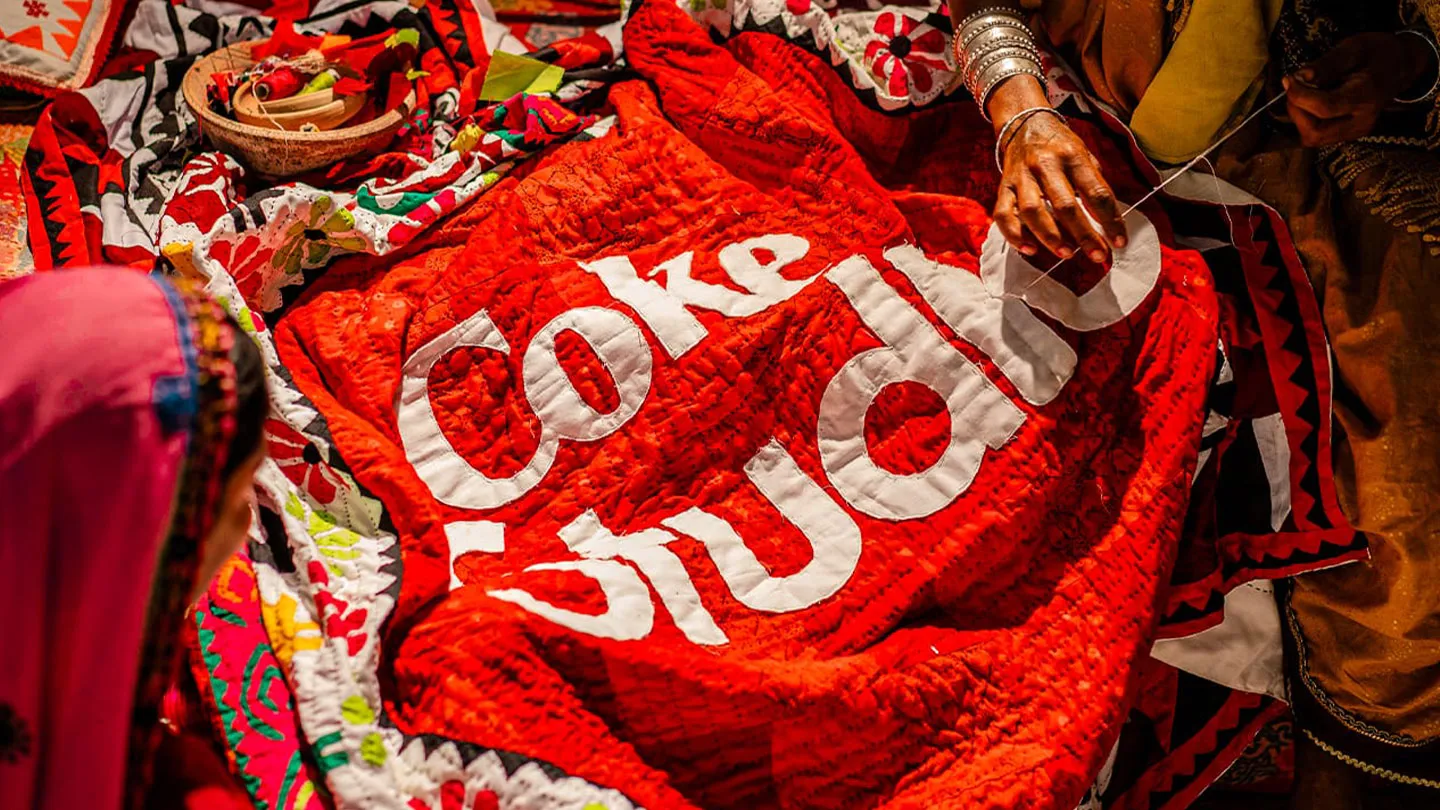
Art director Hashim Ali and stylist Fatima Butt talked about how the visual and conceptual design for ‘Aayi Aayi’ came through the ralli, the Sindh craft of patchwork. They speak about how it represents fragmentation as heritage, and how different things can come together to create something vibrant and whole. The fact that the song itself is part rap, part folk song, with a modern beat yet traditional instruments and takes inspiration from a Sindh folk tale makes it a manifestation of fragmented art; something that is considered modern but actually has been a cultural practice for generations.
Honouring cultural roots has been a central theme in season 15. Pashtun artist Zahoor asks, why is my culture lagging behind when it comes to representation? The first step to fill that gap is the English-Pashto track ‘Harkalay’. Zahoor and Pakistani-American singer REHMA sing of love across borders and barriers, and the hesitation of stepping into a new space, unsure of being accepted, only to realise that beyond the threshold you are being awaited with open arms. The song is an ode to Pashtuns, a people that have often been misunderstood. ‘Harkalay’ isn’t just about welcoming outsiders; it sows a seed of self-acceptance with the knowledge that such cultures need to prove nothing. Their generosity, warmth and humility speaks for itself.
And when it comes to not having to prove anything to anyone, the creative team decided to feature seasoned, mature singers like Sajjad Ali, Kaavish, Zeb Bangash and Shazia Manzoor. The audiovisual concept behind the song ‘Turri Jandi’ was to create a glitch in time, and bring together two artists who existed parallel to each other in different times. The producers considered Shazia Manzoor as the complement to Hasan Raheem; citing them as two people who were like a glitch — existing outside of the standard mould, yet somehow completely relevant. As Xulfi says, smiling, “Kaun ye kehta hai ki glitchiness khubsurat nahi hoti?” (Who says that this glitchiness cannot be beautiful?) The idea of creating a glitch in time, or a parallel universe where people were allowed to be what they were and the subcontinent developed as it could’ve without being colonised, informed the music video as well. The set designers imagined a futuristic Pakistan that was influenced by its past, bringing together a 60s club aesthetic coupled with technology that was made to be South Asian. ‘Turri Jandi’ is one of the more lighthearted songs in season 15, but it has a strong anticolonial message: who we are is linked to our collective past. We must take the future and make it ours, so that we can collectively discover who we could be.
One of the most ambitious collaborations in Coke Studio history is the creation of ‘Piya Piya Calling’. Xulfi reached out to the diaspora duo Karpe, one of the biggest names in contemporary Norwegian pop, Norwegian-Iranian singer Amanda Delara and Baloch singer Kaifi Khalil. QuickStyle featured in the music video. What resulted was a song on love, distance, longing and belonging, with parts sung in Norwegian, Gujarati, Arabic, Urdu and Balochi. The multilingual conversation perfectly fits the nature of the interaction. With questions of home and togetherness being complicated by a growing global culture, Karpe, Delara and Khalil straddle different worlds to build something new and whole from their roots. Thematically similar to ‘Pasoori’, the song connects themes of boundaries and physical space with romantic love. To find yourself a stranger to your own land and to find yourself a stranger to who you love, are both a kind of exile. There is a helplessness and deep longing for what never was, as each singer muses on the search for where and who they belong with. And for someone who has felt separated from their own language, ‘Piya Piya Calling’ feels like a love letter and a consolation, that we are not alone in this loneliness, and that we all deserve to come home.
I love Desi music, but I tapped out of it in my late teens. Coke Studio Pakistan shoved me right back in my seat, asked me to hold its lassi and enjoy the show. The music they have released this year has helped me decolonise my understanding of modern South Asian art and how it interacts with the world. It shows us all that it’s possible to be rooted, and yet be open to others. That sometimes we undervalue our heritage because we let the best of it go unnoticed. We don’t need to adhere to a standard, we don’t need to fit the mould, and it’s okay if our lives don’t come together seamlessly. As long as we create with heart, honesty and honour, we will always find a place to call ours.

Leave a Reply